US mortgage rates: the 30-year fixed rate week by week
In the US the typical mortgage is fixed-rate over 30 years. Freddie Mac, the federal mortgage agency, publishes the average rate on those loans every Thursday in its weekly Primary Mortgage Market Survey, the benchmark used by the press and lenders.
The Federal Reserve does not set that rate directly. It mostly follows the 10-year Treasury yield, because lenders sell or fund these loans in a market that compares their return with government debt. When the 10-year yield rises, mortgage rates tend to rise over the following weeks, and the other way round.
The latest figure
US mortgage rates: the 30-year fixed rises to 7.40%, its highest in a year (October 8, 2026)
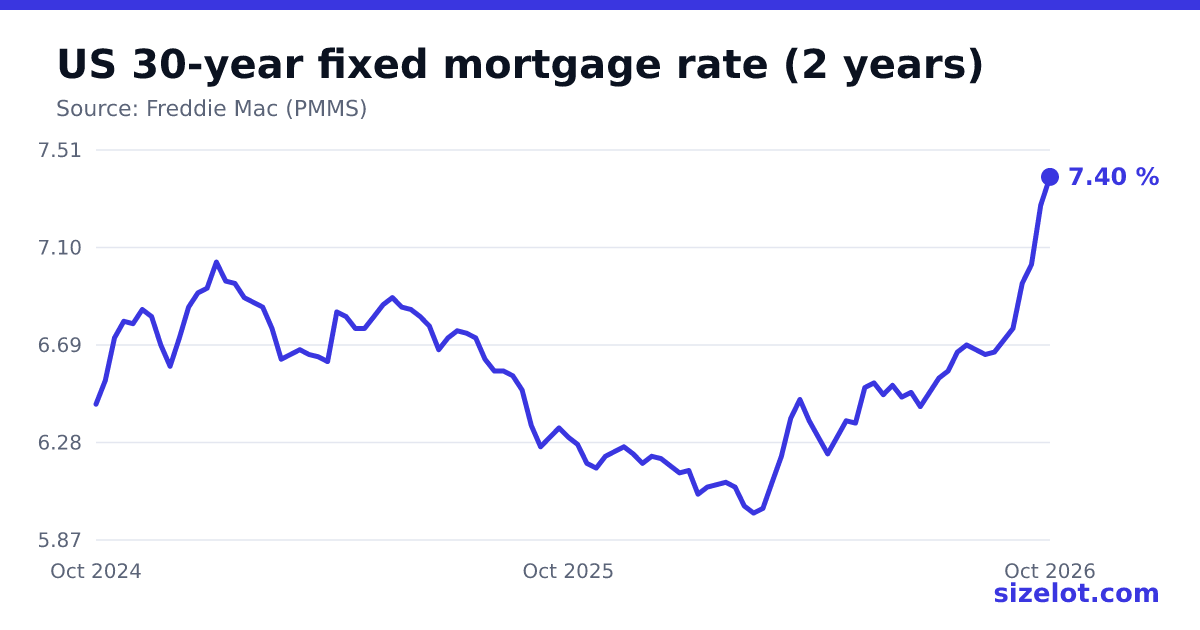
The average 30-year fixed mortgage rate in the US was 7.40% in Freddie Mac’s weekly survey released on October 8, 2026, against 7.28% the week before. A year ago it was 6.30%. Over the last 52 weeks it has ranged between 5.98% and 7.40%.
| $400,000 loan over 30 years | Rate | Monthly payment |
|---|---|---|
| A year ago | 6.30% | $2,476 |
| Previous week | 7.28% | $2,737 |
| This week | 7.40% | $2,770 |
Compared with a year ago, the principal and interest payment rises by $294 a month, $3,524 a year. Property taxes and insurance not included.
Thirty-year mortgages mostly track the 10-year Treasury yield plus a spread, more than the Fed’s rate. When the bond yield rises, mortgages usually get more expensive within days or weeks. Market news.
History
| Date | What happened | Figure |
|---|---|---|
| US mortgage rates: the 30-year fixed rises to 7.40%, its highest in a year | From 7.28% to 7.40% in a week. | |
| US mortgage rates: the 30-year fixed rises to 7.28%, its highest in a year | From 7.03% to 7.28% in a week. | |
| US mortgage rates: the 30-year fixed rises to 7.03%, its highest in a year | From 6.95% to 7.03% in a week. | |
| US mortgage rates: the 30-year fixed rises to 6.95%, its highest in a year | From 6.76% to 6.95% in a week. | |
| US mortgage rates: the 30-year fixed rises to 6.76%, its highest in a year | From 6.71% to 6.76% in a week. | |
| US mortgage rates: the 30-year fixed rises to 6.71%, its highest in a year | From 6.66% to 6.71% in a week. | |
| US mortgage rates: the 30-year fixed rises to 6.69%, its highest in a year | From 6.66% to 6.69% in a week. | |
| US mortgage rates: the 30-year fixed rises to 6.51% | From 6.36% to 6.51% in a week. | |
| US mortgage rates: the 30-year fixed rises to 6.38% | From 6.22% to 6.38% in a week. | |
| US mortgage rates: the 30-year fixed falls to 5.98%, its lowest in a year | From 6.01% to 5.98% in a week. | |
| US mortgage rates: the 30-year fixed falls to 6.01%, its lowest in a year | From 6.09% to 6.01% in a week. | |
| US mortgage rates: the 30-year fixed falls to 6.06%, its lowest in a year | From 6.16% to 6.06% in a week. | |
| US mortgage rates: the 30-year fixed falls to 6.15%, its lowest in a year | From 6.18% to 6.15% in a week. | |
| US mortgage rates: the 30-year fixed falls to 6.17%, its lowest in a year | From 6.19% to 6.17% in a week. | |
| US mortgage rates: the 30-year fixed falls to 6.19%, its lowest in a year | From 6.27% to 6.19% in a week. |
Why it matters even if you are not buying a house
Housing is a large part of the US economy: dearer mortgages slow home sales, construction and spending. That makes the mortgage rate a gauge of how Fed decisions and bond moves reach the real economy.
For a trader, a sharp rise in mortgage rates usually comes with a rising 10-year yield and a strong dollar, and can weigh on homebuilders and regional banks in the S&P 500. This site only records a change when the rate moves 0.15 points or more in a week, or hits its highest or lowest level of the past year.
This page updates itself every Thursday with a move like that, using Freddie Mac’s figure. This is not financial advice: the rate a lender offers you depends on your profile.
To use with this data: Fed interest rates · 10-year yield moves · Compound interest calculator.
Information based on published official data. This is not investment advice: leveraged trading can lose you more than you invest.
Frequently asked questions
What is the latest figure?
US mortgage rates: the 30-year fixed rises to 7.40%, its highest in a year (October 8, 2026). From 7.28% to 7.40% in a week.
Who publishes US mortgage rates?
Freddie Mac, every Thursday, in its Primary Mortgage Market Survey: the average rate on a 30-year fixed mortgage.
Why do mortgage rates rise when the Fed has not raised rates?
Because they mostly follow the 10-year Treasury yield, which moves with expectations for inflation and the Fed, not only with its decisions.