ECB interest rates: latest decision, history and what they move
The European Central Bank sets three official interest rates for the euro area. The one that steers its policy is the deposit facility rate: what banks earn on money they leave at the ECB overnight. The other two move with it: the main refinancing operations rate, 15 basis points higher since September 2024, and the marginal lending facility, 25 basis points above that.
Decisions are taken by the Governing Council at its monetary policy meetings, eight a year, roughly every six weeks. The statement comes out at 14:15 Frankfurt time (8:15 a.m. in New York for most of the year) and the press conference starts at 14:45. Changes usually apply from the Wednesday after the meeting.
The latest figure
The ECB raises rates by 25 basis points: deposit facility at 2.50% (September 16, 2026)
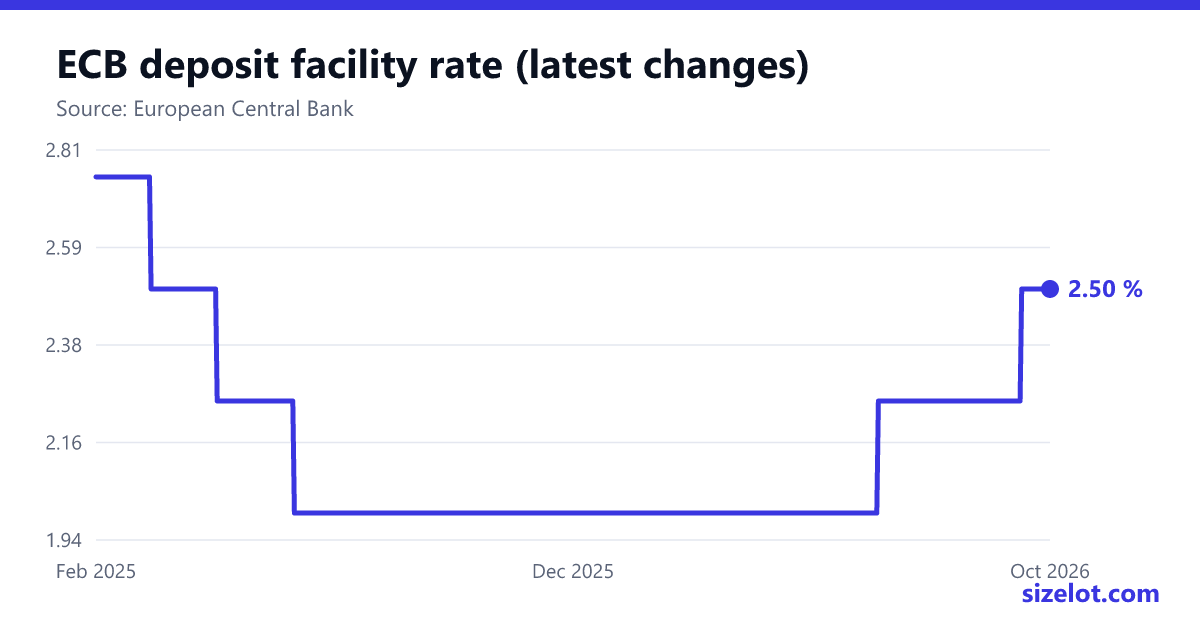
The European Central Bank has raised the deposit facility rate, the one that sets its policy stance, by 25 basis points from 2.25% to 2.50%, effective September 16, 2026.
| Effective | Deposit facility |
|---|---|
| September 16, 2026 | 2.50% |
| June 17, 2026 | 2.25% |
| June 11, 2025 | 2.00% |
| April 23, 2025 | 2.25% |
| March 12, 2025 | 2.50% |
| February 5, 2025 | 2.75% |
ECB rates move the euro against other currencies and the overnight swap on EUR pairs, and affect the DAX and the Euro Stoxx 50. Central bank calendar.
History
| Date | What happened | Figure |
|---|---|---|
| The ECB raises rates by 25 basis points: deposit facility at 2.50% | From 2.25% to 2.50%. | |
| The ECB raises rates by 25 basis points: deposit facility at 2.25% | From 2.00% to 2.25%. |
What an ECB decision moves
Euribor, the index behind most variable-rate mortgages in Spain and several other euro countries, moves ahead of what the market expects the ECB to do: that is why it often falls or rises before the meeting rather than after it. Short-term government bills and bonds follow the same path.
In the currency market, an unexpected hike tends to lift the euro against the dollar and an unexpected cut tends to weaken it. What matters most is not the decision, which is almost always priced in, but what the ECB says about the next ones. In the minutes after the statement and during the press conference, EUR/USD can move tens of pips quickly, with wider spreads than usual.
How to trade on ECB day
If you trade euro pairs that day, size your position for a wider stop, not the other way round: the money at risk should stay the same as always. The lot size calculator tells you how many lots match your risk with that stop. The dates of every meeting are in the ECB calendar for this year and the next.
This page updates itself whenever the ECB changes its rates: the figures are read from its official website every morning and nothing is published unless the value passes a range check.
To use with this data: ECB meeting calendar · EUR/USD lot size calculator · All central bank calendars.
Information based on published official data. This is not investment advice: leveraged trading can lose you more than you invest.
Frequently asked questions
What is the latest figure?
The ECB raises rates by 25 basis points: deposit facility at 2.50% (September 16, 2026). From 2.25% to 2.50%.
Which ECB rate matters most?
The deposit facility rate. Since 2024 the ECB uses it to steer policy; the other two official rates move with it at a fixed distance.
How often does the ECB meet?
Eight times a year to set rates, roughly every six weeks. The statement is released at 14:15 Frankfurt time and the press conference starts at 14:45.
How do ECB rates affect the euro?
A surprise hike tends to strengthen the euro and a surprise cut tends to weaken it. Most decisions are priced in, so the guidance about future meetings usually moves EUR/USD more than the decision itself.